A stranger from Minnesota stopped in front of the old photograph by the register at Calloway's Store and said, "That's my grandmother," and Inez Calloway nearly dropped a jar of pickled okra on her foot.
"No, honey," Inez said. "That's my mother."
The photograph had hung on that nail by the register since 1946. It showed two girls of seventeen in matching cotton dresses, standing on the front porch of the store in the summer of 1931 with their arms around each other's waists. They had the same dark hair and the same pointed chin and the same crooked smile, as if somebody had just told them a joke they were not supposed to laugh at.
The one on the left was Lottie Calloway, Inez's mother. Inez had always been told the one on the right was a cousin from Vicksburg.
The young woman had a phone in her hand. She held it up beside the photograph. On the screen was a black-and-white picture of a girl in a cap and gown, about seventeen. Same dark hair. Same chin. Same crooked smile.
"This is my grandmother Lula," she said. "In Minnesota, the year she left home."
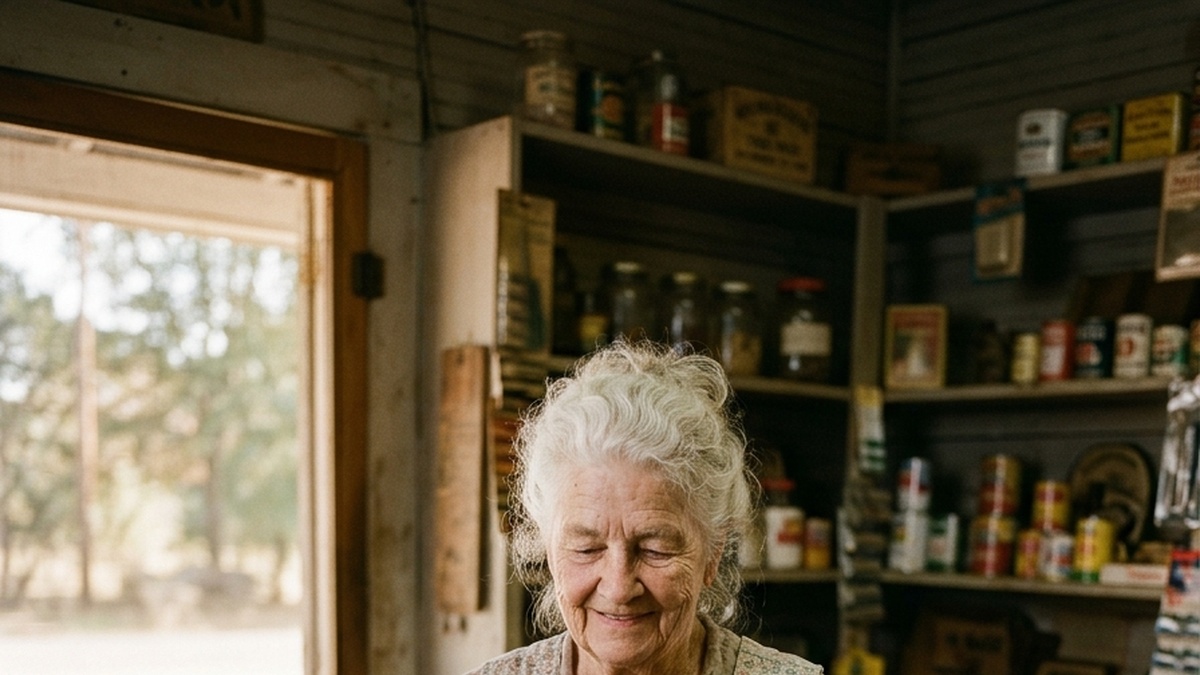
Calloway's Store sat on the river road in Bayou Laurel, Mississippi, a little town that had shrunk every year since the cotton gin closed. It sold groceries, hardware, fishing bait, and stamps. Inez had run it for sixty-one years, since she was twenty-three, and she was eighty-four now and did not intend to stop.
The young woman said her name was Nora Lindqvist and that she taught high school history in Duluth. She had driven nine hundred miles because of a box of papers she found when her mother died in the spring.
"My grandmother was born in Mississippi in 1914," Nora said. "She went north to Minnesota to work for a farm family when she was seventeen, and she married there, and she never came back. She never told us why. She hardly talked about Mississippi at all. She died in 1998." Nora looked at the photograph again. "She used to sing me a song when I was little. She said it was the only thing she had from home."
Inez felt the floor of the store tilt very slightly under her feet.
"What kind of song?" she asked.
Before Nora could answer, the screen door banged, and Inez's nephew Dwight came in from the parking lot with a clipboard under his arm.
Dwight was fifty-five. He was Inez's late brother's boy, and he had been helping with the store for ten years, which mostly meant doing the books and worrying. He was a decent man and a nervous one. For six months, he had been talking to a company from Jackson that wanted to buy the store and the river lot behind it to build a boat landing and a bait shop.
The papers were ready. Inez had not signed them.
Dwight looked at Nora, then at her phone, then at the photograph. His face closed up.
"Aunt Inez," he said, "can I speak to you a minute? In the back."
In the stockroom, between the dog food and the motor oil, Dwight kept his voice low.
"I know what this is," he said. "I read about it. People find an old picture online, they do one of those DNA tests, they show up in some little town saying they're family. Next thing you know, there's a lawyer."
"Dwight, she's a schoolteacher."
"I'm sure she is. And we've got a contract on this place that the whole family's counting on." He rubbed his face. "Your mother never had a sister. You told me that yourself. Grandma Lottie was an only child."
"That's what I was told," Inez said.
"Then that's what's true." He took a breath. "I'm sorry. I'll be polite. But I'm going to ask her to go."
Inez went back out front. She should have stopped him. Later, she would wish she had. But she was eighty-four, and her mother had been dead for forty years, and she had been told one thing her whole life. It is hard to put down something you have carried that long, even when your arms are tired.
Dwight was already at the counter.
"Miss Lindqvist, I'm sure you mean well," he said. "But my grandmother was an only child, and this family is in the middle of some business. I think it'd be best if you didn't come back."
Nora looked at him. Then at Inez. Her face went red, then pale.
"I'm not here for anything," she said quietly. "I just wanted to see where she came from."
She picked up her bag and walked out. The screen door slapped shut behind her.
Inez stood at the counter with her hand on the photograph frame. Through the front window, she watched Nora cross the gravel lot to a little blue car with Minnesota plates. Nora put her bag on the passenger seat. She sat for a moment with both hands on the wheel. She rolled her window down, because the afternoon was warm for November.
Then, very softly, the way a person does when she is trying not to cry, she began to sing.
The tune came across the gravel lot and through the screen door. Inez knew it before the second line. She had heard it every night of her childhood, sitting on her mother's lap on that same porch. For eighty-four years, she had believed she was the last living soul who knew it.